What Are Business Systems?
Why Every Business Needs Systems
Essential Elements of Effective Systems
Real-World Success Stories
How to Implement in Your Organisation
How to Overcome Common Challenges
The ROI: Why Investment Pays Off
Advanced Business Systems Strategies
Frequently Asked Questions
Getting Started: Your Action Plan
The Hidden Cost of Operating Without Business Systems
Most business owners never set out to become the bottleneck. It happens slowly. The business grows, the team grows and somehow every question, decision and fix still lands on your desk.
The knowledge that runs the business is all in your head.
That’s as true of successful businesses as it is of struggling ones. Even a business that’s doing well can get dramatically better results once the work is captured in documented systems instead of people’s memories.
Without those systems, owners stay trapped in operational chaos, no matter how hard they work.
Consider Gary McMahon, who founded Ecosystem Solutions in 2005. His ecological consulting business experienced rapid growth, attracting clients from governments, corporations and families. Success came at a devastating personal cost: 100-hour weeks that put his health, his marriage and time with his kids at risk. Despite hiring staff and attempting to expand, he remained the quintessential bottleneck in his own business.
Businesses without documented processes lose productive time to redundant or inefficient activities. Employees spend hours searching for information that should be readily available. Customer experiences become inconsistent because there’s no standard approach to service delivery. Critical knowledge walks out the door when key team members leave.
The symptoms manifest everywhere once you recognise them:
- Constant firefighting instead of strategic work
- New employees taking months to reach productivity because there’s no clear training process
- Same mistakes happening repeatedly because there’s no system to prevent them
- Business owners who can’t take vacations because everything depends on their direct involvement.
Most devastating of all are the invisible opportunity costs.
How many strategic initiatives never get launched because leadership remains trapped in operational details? How many potential partnerships, growth opportunities, or innovations get overlooked because there’s no capacity to think beyond immediate problems?
What Are Business Systems – Definition and Core Concepts
A business system is fundamentally a procedure, process, method, or course of action designed to achieve a specific and predetermined result. Think of it as a recipe where component parts and interrelated steps work together for a desired outcome. Creating effective business systems represents the only way to attain results that are consistent, measurable, beneficial to customers and workers and yield expected profits.
These are people systems, not mechanical or electrical systems. They might include lead generation, customer service, production, order fulfillment, purchasing, inventory management, hiring, training and many others unique to your company. These systems create the daily rhythm of business activities that determine your success and profitability.

The distinction between systems and processes often creates confusion. A process typically refers to a series of actions or steps taken to achieve a particular result. A system encompasses the broader framework that includes processes, people, tools, resources and feedback mechanisms working together toward strategic objectives. Systems provide the architecture within which processes operate effectively.
Every successful business operates on systematic principles, whether formally documented or informally understood. The question isn’t whether your business has systems, but whether those systems are intentionally designed, clearly documented and consistently executed to create competitive advantage.
Why Every Business Needs Systematic Operations
Building Blocks of Sustainable Success
Effective business systems represent the essential building blocks of your company, regardless of whether you operate a product-based, service-based, or non-profit organisation. They’re important to offices, workshops, factories and retail stores alike. The critical purposes extend beyond simply getting organised or systemised to consistently attracting and retaining customers, eliminating waste and inefficiency and setting your company apart in crowded marketplaces.
Systems and processes determine how employees accomplish routine work. Unfortunately, in many small businesses, they develop haphazardly as people come and go. The good news is that building systems is a skill anyone can learn and it applies to every part of the business: marketing, finance, operations and beyond.
As Michael Gerber emphasises in E-Myth, “the business owner must work ON the business, not just IN the business.” Whether through hands-on involvement or overseeing others, you can work ON your business intelligently and systematically by creating valuable systems that continually please customers and accomplish objectives. This represents one of your key responsibilities and optimal use of time.
The systematic approach creates remarkable competitive advantages. When your operations run predictably and efficiently, you can focus energy on strategic initiatives rather than firefighting daily problems. Your team members operate with confidence because they understand exactly how to deliver consistent results. Customers receive reliable experiences that build trust and loyalty over time.
Cost-Effectiveness and Market Advantage
Competition in every industry continues intensifying. Customers consistently seek the “best deal,” which sometimes means lowest price but always includes acceptable quality, promptness, value and positive buying experiences. The quality and efficiency of your business processes largely determine operating costs and your ability to compete profitably.
Good business systems help you be better, faster and more cost-effective than your competitors. This isn’t theory. When processes cut waste, reduce errors and speed up delivery, lower costs follow.
Consider how systematic operations enable superior customer value propositions. Documented processes ensure consistent quality delivery regardless of which team member serves the customer. Streamlined workflows reduce processing time, enabling faster response and delivery. Efficient resource utilisation lowers operational costs, creating margin for competitive pricing or enhanced service levels.
Your systematic capabilities become increasingly valuable as market competition intensifies. Companies operating with ad hoc processes struggle to maintain consistency under pressure. Those with robust operational systems can scale efficiently, adapt quickly to changing conditions and maintain quality standards during growth periods.
Transforming Ordinary People into Extraordinary Performers
Perhaps the most powerful aspect of effective business systems lies in their ability to amplify human capabilities. Established systems and processes become your most valuable business assets when they can continually produce desired results. People represent the most important components within working processes, but people come and go while systems remain constant.
Ordinary individuals can produce results far above their pay grade when operating within well-designed and effective systems. Good business systems reduce mistakes, waste and rework while allowing workers to capably perform higher-level tasks. This systematic amplification creates tremendous organisational leverage.

When problems occur, effective systematic thinking focuses on system improvement rather than individual blame. This perspective transforms finger-pointing into collaborative problem-solving while building organisational learning capacity. Team members feel supported rather than threatened, encouraging innovation and continuous improvement suggestions.
10 Essential Elements of Effective Business Systems
1. Documented Best Practices
System building represents both the art and science of developing “best practices” throughout your organisation. The art emerges from your unique vision, creative approach to problem-solving and desire to differentiate yourself in the marketplace. The science applies proven methodologies including Six Sigma, Lean Thinking and Theory of Constraints principles.
A systematic approach to running your business includes focus on process design, system components, people development, quality control, speed optimisation and performance measurement. Business systems literally become the “recipes” for best practices that enable consistent work completion throughout your organisation.
Documentation transforms tribal knowledge into transferable organisational assets. The goal isn’t creating dust-gathering manuals but developing practical guides that ensure consistent execution regardless of personnel changes. Effective documentation includes step-by-step procedures, required resources, quality standards and success metrics.
Best practices emerge through careful observation, stakeholder input and iterative refinement. The documentation process involves identifying what currently works well, standardising successful approaches and creating procedures that new team members can follow to achieve consistent results with minimal supervision.
“Documentation isn’t about creating dusty manuals, it’s about turning your best practices into assets that drive consistent results, no matter who’s on the team.”
2. Problem-Solving and Transparency
Systems thinking literally makes your business transparent, allowing you to clearly see root causes of problems and their obvious solutions. This systematic approach quickly eliminates customer complaints, operational waste, mediocre performance, worker turnover, unnecessary costs, poor cash flow, slow sales growth, small profit margins and daily frustration.
You can establish cultures of discipline and excellence through smooth-running business systems, performance feedback to workers and empowering motivation of accountability. Documented business processes provide “visual schematics” for problem-solving, innovation and creating result-driven cultures.
The systematic perspective transforms how organisations handle challenges. When problems arise, systematic thinkers examine processes and system design rather than immediately assigning individual responsibility. This approach identifies underlying causes that, when addressed, prevent similar problems from recurring.
Problem-solving frameworks become embedded within systematic operations. Regular review processes examine performance data, customer feedback and operational metrics to identify improvement opportunities. Teams develop capabilities for collaborative problem-solving that builds organisational intelligence over time.
3. Continuous Improvement Framework
Someone has to own improvement. In SYSTEMology, that person is the Systems Champion: the team member who keeps your systems current, gathers feedback from the people using them and looks for ways to improve service, cut costs and save time.
The Systems Champion doesn’t write every system. The people doing the work do that. The Champion keeps the effort moving, makes sure systems get used and flags the ones that need updating.
The simplest vehicle for this is a short, regular improvement meeting. Pick one problem, look at the system behind it and agree on the fix. These sessions improve people, products and processes by getting the team thinking critically, solving problems together and buying in to the changes.
Small weekly improvements add up. Over a year, they deliver happier customers, happier employees and larger profits, without the disruption of a major overhaul.
4. Critical Client Flow (CCF) Documentation
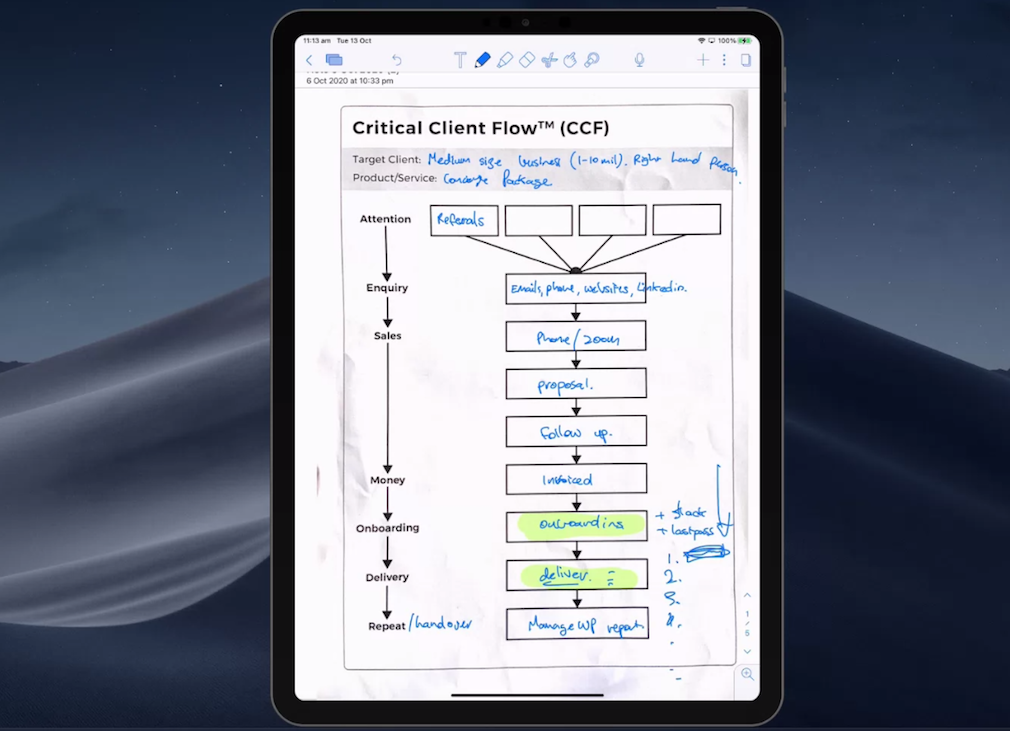
The Critical Client Flow represents your business’s foundational system, documenting how one specific client type experiences your complete service delivery process for one primary product or service. This exercise forces clarity about your core value proposition and reveals improvement opportunities throughout the customer journey.
Creating your CCF begins with identifying your primary target client and your most important product or service offering. Map every step from initial awareness through final delivery and follow-up, including all touchpoints, decision points and handoffs between departments or team members.
The goal involves explaining in simple terms how your business works from start to finish in linear fashion. Test your completed CCF by sharing it with someone outside the business who understands roughly what you do but isn’t directly involved. If they can understand it without detailed explanation, you’ve achieved appropriate clarity.
Your CCF becomes the foundation for identifying other critical systems throughout your organisation. Each step in the customer journey typically requires supporting systems for effective execution. This systematic approach ensures you focus on processes that directly impact customer experience and business results.
5. Minimum Viable Systems (MVS) Approach
The concept of documenting hundreds of systems often overwhelms business owners and prevents systematic implementation. The Minimum Viable Systems approach focuses on the 7-10 critical processes per department that, when documented and optimised, create the biggest impact on operational efficiency.
Rather than attempting to systematise everything simultaneously, the MVS approach prioritises systems based on their direct impact on customer experience, revenue generation, or cost control. This strategic focus creates momentum through early wins while building systematic capabilities.
Each department typically has core systems that drive most of their results. Sales departments might focus on lead qualification, proposal development and client onboarding processes. Operations might prioritise quality control, delivery coordination and customer communication systems. Administration could emphasise hiring, training and performance management processes.
The MVS approach prevents the common mistake of getting bogged down in documentation without seeing tangible improvements. By focusing on highest-impact systems first, organisations experience immediate benefits that justify continued investment in systematic development.
”Don’t try to systemise everything at once. Focus on the critical few processes that make the biggest impact, get those right and momentum will carry the rest.”
6. Quality Control and Performance Measurement
Systems without measurement and accountability quickly deteriorate back to inconsistent execution. Effective business systems include built-in quality control mechanisms and performance measurement frameworks that ensure consistent delivery and identify improvement opportunities.
Quality control systems might include checklists, review processes, customer feedback mechanisms and performance standards. The goal involves creating systematic approaches to maintaining quality rather than depending on individual vigilance or post-problem correction.
Performance measurement focuses on both system compliance and system effectiveness. Tracking mechanisms monitor whether team members follow established procedures while also measuring whether those procedures deliver intended results. This dual focus ensures systems remain both used and useful.
Key performance indicators should connect directly to business objectives while remaining simple enough for regular monitoring. Dashboard approaches provide visual feedback that helps team members understand performance relative to standards and identify areas needing attention.
7. Training and Knowledge Transfer Systems

Systematic organisations develop comprehensive approaches to onboarding new team members and maintaining skill development among existing staff. Training systems ensure consistent knowledge transfer while building organisational capabilities for continuous learning.
Effective training goes beyond procedure documentation to include understanding of why systems matter and how individual contributions connect to overall business success. This systematic approach helps team members develop systems thinking as a mindset rather than mere compliance with specific procedures.
Knowledge transfer systems capture expertise from experienced team members and make it accessible throughout the organisation. This systematic approach reduces dependency on individual knowledge holders while building organisational resilience.
Regular training reinforcement proves more effective than intensive one-time programs. Systematic training schedules provide ongoing learning opportunities that reinforce system usage, address implementation questions and celebrate improvements emerging from team feedback.
8. Scalability and Growth Preparation
The most valuable business systems are designed to grow with your business rather than constraining expansion. Scalable systems can handle increased volume, additional complexity, or geographic expansion without requiring complete redesign.
Forward-thinking system design considers how current decisions affect future capabilities. Systems that work effectively for 10-person companies might break down at 50 people unless designed with scalability considerations from the beginning.
Scalability planning includes developing organisational capabilities needed to maintain system quality during growth periods. This might involve training additional system administrators, implementing more sophisticated measurement tools, or creating more robust change management processes.
Growth preparation also considers business model evolution. Companies that successfully scale often expand into new markets, develop new products, or modify service delivery approaches. Systems must maintain enough flexibility to accommodate strategic shifts while preserving operational excellence.
9. Technology Integration and Automation
Technology can significantly enhance systematic operations, but effective implementation requires thoughtful integration rather than haphazard tool adoption. The principle of “think like Google” applies here: perfect manual processes before automating them.
Google’s approach to automation involves identifying improvement opportunities, creating hypotheses, developing supporting documentation, testing extensively with human oversight and only then incorporating changes into automated systems. This systematic approach prevents automating ineffective processes.
Systems management software creates central locations for all business systems and processes, making them easily accessible to team members while maintaining version control and update capabilities. Purpose-built systems management platforms prove superior to scattered storage across multiple file systems.
The selection criteria for systems management tools should include dedicated systems functionality, rich media attachment capabilities, permission level controls, sign-off mechanisms and intuitive ease of use. These platforms house your most important business assets and deserve appropriate investment.
10. Cultural Integration and Buy-In
Building systems-oriented culture requires more than documentation and training. Cultural transformation involves helping team members understand how systematic approaches benefit their daily work experience while contributing to organisational success.
Many team members initially view systems as constraints on autonomy or implied criticism of current methods. Effective cultural integration focuses on how systems solve real problems people experience daily, reduce stress and confusion and enable higher-level contributions.
Cultural change happens through education, demonstration of benefits and celebration of systematic successes. Sharing improvement stories, highlighting efficiency gains and recognising team members who contribute system enhancements builds momentum for continued adoption.
The goal involves making systematic operations the “path of least resistance” throughout the organisation. When following systems becomes easier than working around them, cultural integration has succeeded. This requires ongoing attention to system usability and relevance.
How strong are your business systems right now?
Take the free 2-minute System Strength Test. It scores your business across
9 dimensions and shows you exactly where to focus first.
How strong are your business systems right now?
Take the free 2-minute System Strength Test. It scores your business across 9 dimensions and shows you exactly where to focus first.
Take the Free System Strength Test →Real-World Business Systems Success Stories
Case Study 1: Ecosystem Solutions Transformation
Gary McMahon’s transformation shows what documented systems can do for an owner who is close to breaking point. Working 100-hour weeks, he knew something had to change or he risked losing his marriage, his time with his kids and the business itself.
The Critical Client Flow was the turning point. In Gary’s words: “The CCF process was what made it for me.” It let him and his team see the bottlenecks and build processes that fit together. The stress took a few months to lift and the numbers followed: by 2026, Gary reported turnover up 338% across roughly ten years.
Today the documented systems carry the load. His newest hire arrived from Finland with no Australian ecological knowledge and was onboarded straight off them. Gary even found the time to earn his pilot’s licence, so he now flies himself to remote sites instead of driving for three days.
This transformation shows how systematic operations create both business results and personal freedom for owners willing to put in the work.

Case Study 2: Lime Therapy Hands Systems to the Team
Renee and Matt Kelly run Lime Therapy, a multi-disciplinary allied health practice of around 40 staff serving rural and remote Australia. As the practice grew, the owners became the bottleneck.
Their Systems Champion wasn’t a manager. It was a junior occupational therapist, chosen deliberately. Systems built by the people who do the work are systems that get used and that changed everything.
Invoicing and wages went from full-day jobs to a couple of hours each. SYSTEMology language is now part of how the team talks and staff propose new systems themselves instead of waiting to be told.
The same principle works at any scale. Discount Tire grew from its first store in 1960 to more than 1,200 stores across 40 states on the back of systematic operations, proof that systems create lasting competitive advantages.
What is operating without systems actually costing you?
Most business owners are shocked when they see the number.
Use our free calculator to find out.
How to Implement Business Systems in Your Organisation
Step 1: Assess Your Current System Maturity
Before implementing systematic improvements, conduct honest assessment of your current operational foundation. Map existing processes across all departments, identifying which procedures are completely undocumented, partially documented, or well-documented but inconsistently followed.
Look for areas where tribal knowledge creates vulnerability or where inconsistent execution affects customer experience. Consider your organisation’s readiness for systematic change by assessing leadership support, team openness to new approaches and available resources for system development.
The assessment should evaluate current tools and technology infrastructure. Systems work best when supported by appropriate technology, but they don’t require expensive software to get started. Understanding your technology baseline helps plan realistic implementation timelines.
Document findings in a systematic audit that prioritises improvement opportunities based on customer impact, revenue generation and operational efficiency. This assessment becomes the foundation for strategic system development planning.
Step 2: Define Your Critical Client Flow
Creating your Critical Client Flow provides the systematic foundation for all other business systems. Begin by identifying one primary target client and one primary product or service you deliver to that client type.
Map every step from initial awareness through final delivery and follow-up. Include all touchpoints, decision points, handoffs between departments and quality control mechanisms. Focus on explaining how your business works from start to finish in linear fashion.
Test your completed CCF by sharing it with someone outside your business who understands roughly what you do but isn’t directly involved. If they can understand it without detailed explanation from you, you’ve achieved appropriate clarity and simplicity.
Your CCF becomes the foundation for identifying supporting systems throughout your organisation. Each step typically requires underlying processes for effective execution, providing natural prioritisation for subsequent system development efforts.
Step 3: Identify Your Minimum Viable Systems
Rather than attempting to document everything simultaneously, focus on 7-10 critical processes per department that create the biggest impact when systematised. These Minimum Viable Systems drive most of your operational results and customer experiences.
Sales departments might prioritise lead qualification, proposal development and client onboarding systems. Operations could focus on quality control, delivery coordination and customer communication processes. Administration might emphasise hiring, training and performance management systems.
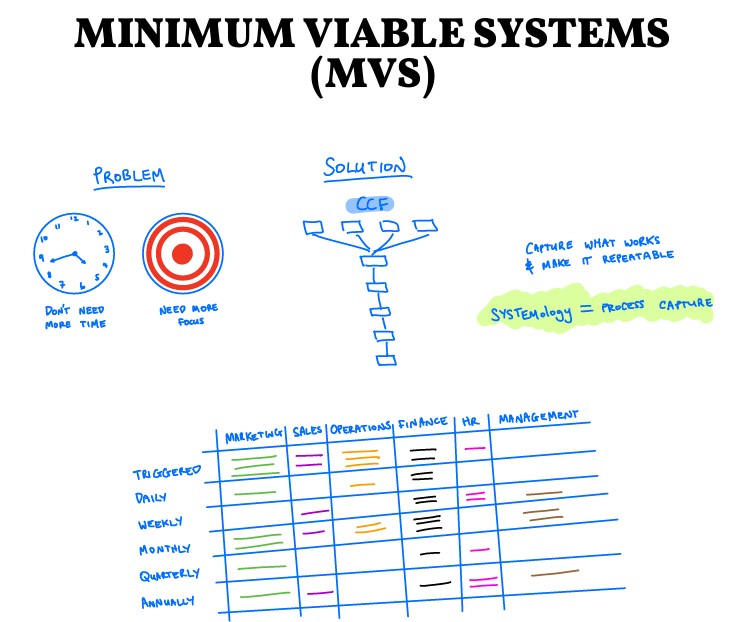
Select systems based on their direct impact on customer experience, revenue generation, or cost control. This strategic approach creates momentum through early wins while building systematic capabilities throughout your organisation.
Document your MVS priorities in a master systems blueprint that guides development efforts over the coming months. This systematic approach prevents scattered efforts while ensuring focus on highest-impact improvements.
Step 4: Extract and Document Core Processes
System extraction involves careful observation, stakeholder interviews and process mapping to capture how work currently gets accomplished. The goal isn’t just recording what happens but identifying best practices that should become standard operating procedures.
Documentation should include clear step-by-step procedures, required resources, quality standards and success metrics. Create processes detailed enough to ensure consistent execution but accessible enough that people actually use them regularly.
Consider edge cases, decision points and quality control measures that ensure systems work reliably under real-world conditions. Each documented system should enable new team members to follow procedures and achieve consistent results with minimal supervision.
Use visual process maps, checklists and multimedia training materials rather than dense text documents. The goal involves creating usable references that support daily work rather than comprehensive manuals that gather dust.
Step 5: Establish Your Systems Management Platform
Central storage and organisation of business systems requires purpose-built platforms rather than scattered file storage across multiple systems. Systems management software creates accessible repositories for your most important business assets.
Selection criteria should include dedicated systems management functionality, rich media attachment capabilities, permission level controls, sign-off mechanisms and intuitive ease of use. Avoid document management platforms that quickly become disorganised or wiki-style solutions requiring technical expertise.
Your systems management platform should make it easy for team members to find, follow and update procedures as improvements are identified. This central approach ensures version control while enabling collaborative enhancement of systematic operations.
Implementation should begin simply and build complexity gradually. Basic systems can start in word processing documents before investing in sophisticated platforms, but plan migration to dedicated systems management tools as your systematic capabilities develop.
Looking for a platform built for exactly this?
systemHUB is purpose-built for business systems, with 100+ ready-made templates across Sales, Marketing, Operations, HR and Finance.
Start Your Free Trial →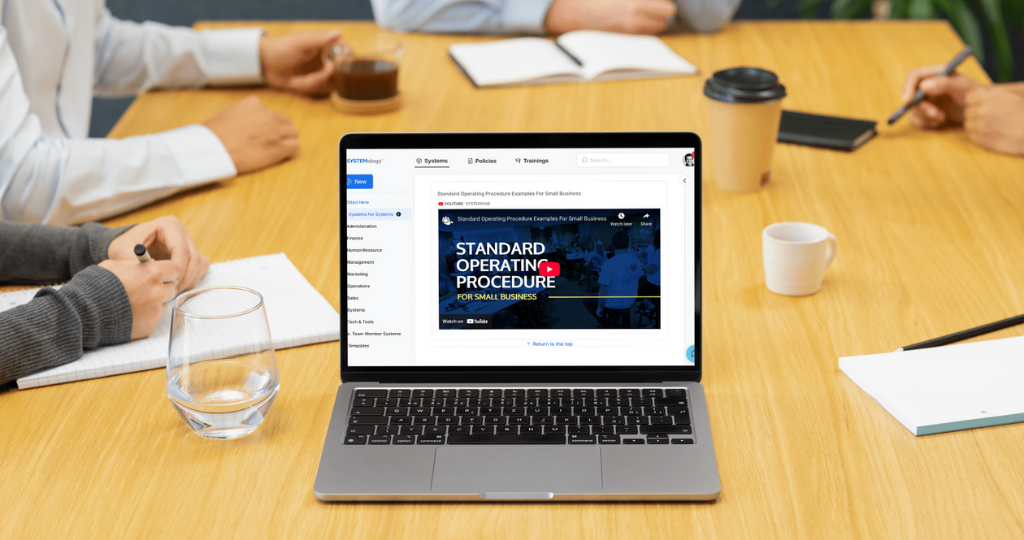
Step 6: Train Teams and Build Culture
Effective training goes beyond procedure documentation to help team members understand why systems matter and how they contribute to business success. This systematic approach builds systems thinking as organisational mindset rather than mere compliance.
Training programs should make systems accessible and engaging rather than bureaucratic and boring. Interactive workshops, hands-on practice sessions and peer-to-peer learning opportunities help people develop comfort with systematic approaches.
Regular training sessions outperform intensive one-time programs. Establish ongoing learning opportunities that reinforce system usage, address implementation questions and celebrate improvements emerging from team feedback.
Appoint one Systems Champion to own the whole effort, then develop internal champions who support system adoption within their respective departments. These advocates become valuable allies in sustaining cultural change while identifying opportunities for system refinement and enhancement.
Step 7: Monitor, Measure and Optimise
Systems without measurement and accountability quickly deteriorate back to inconsistent execution. Establish tracking mechanisms that monitor both system usage and system effectiveness while creating transparency around performance.
Key performance indicators should connect system performance to business results while remaining simple enough for regular monitoring. Dashboard approaches provide visual feedback that helps teams understand performance relative to standards. If you already run a leadership framework such as EOS or Scaling Up, these measures can feed straight into its scorecard. Here’s how the best business operating systems compare.
Create regular review processes that examine performance data, customer feedback and operational metrics to identify improvement opportunities. This systematic approach to optimisation ensures continuous enhancement of operational capabilities.
When compliance issues arise, focus on identifying obstacles that prevent people from following systems rather than immediately assigning blame. Sometimes non-compliance indicates system refinement needs rather than individual correction requirements.
Common Challenges and How to Overcome Them
Every organisation implementing business systems encounters predictable obstacles. Understanding these challenges and having strategies to address them significantly improves implementation success rates.
Resistance to change represents the most common challenge. Team members may view systems as bureaucratic overhead or implied criticism of current methods. Address this by focusing on how systems solve real problems people experience daily while demonstrating that systematic approaches ultimately make work easier.
Time constraints create frequent obstacles when people claim they’re too busy to document processes or attend training sessions. Counter this by demonstrating that short-term time investment creates substantial long-term time savings through reduced confusion and rework.
Technology adoption can present significant hurdles, especially in organisations with limited technical expertise. Start simple and build complexity gradually rather than implementing sophisticated platforms before teams are ready to use them effectively.
Progress is sustained through consistent effort, as early enthusiasm tends to decline once competing priorities surface. Combat this by regularly communicating progress, celebrating improvements and connecting system benefits to business results that matter to leadership.
The ROI of Business Systems: Why Investment Pays Off
Exceptional business systems consistently pay for themselves through multiple financial and operational benefits. In the words of Ken Stork, former president of the Association of Manufacturing Excellence: if a needed process isn’t installed, the organisation ends up paying for it while receiving no benefit.
Financial benefits include cost savings from reduced errors, time savings from streamlined processes, revenue increases from improved customer experiences and risk reduction from standardised quality controls. The larger your company, the greater the potential benefit from systematic operations.

Business valuation increasingly reflects operational maturity and systematic capabilities. Companies with documented, systematic operations command higher multiples because buyers can see how the business generates results independent of key individuals.
The systematic foundation enables rapid adaptation to market changes, efficient scaling during growth periods and confident delegation of responsibilities. This operational flexibility becomes increasingly valuable as business environments become more dynamic and competitive.
Risk reduction represents another significant return on systematic investment. Documented processes prevent critical knowledge from walking out the door when key employees leave. Standardised quality controls reduce liability exposure and customer dissatisfaction. Systematic operations create business resilience that protects against operational disruptions.
Advanced Business Systems Strategies
Automation and AI Integration
Modern business systems increasingly incorporate artificial intelligence and automation technologies to enhance operational efficiency. However, successful implementation requires systematic approaches that perfect manual processes before automating them.
The principle of “think like Google” applies directly to AI integration. Google’s search team identifies improvement opportunities, creates hypotheses with supporting documentation, tests extensively with human oversight and only then incorporates changes into automated systems. This systematic approach prevents automating ineffective processes.
AI tools can enhance many systematic processes including content creation, customer service responses, data analysis and routine administrative tasks. The key involves identifying repetitive, rule-based activities that benefit from artificial intelligence while maintaining human oversight for quality control and strategic decision-making.
Start with simple AI implementations that complement existing systems rather than replacing them entirely. Document AI-enhanced processes just as thoroughly as manual procedures, including fallback mechanisms for when technology assistance isn’t available or appropriate.
Franchise and Replication Preparation
Systematic operations create the foundation for business replication through franchising, licensing, or multi-location expansion. Many companies have scaled through this method. Discount Tire’s growth, mentioned earlier, shows the power of well-designed business systems.
Replication readiness requires documenting not just operational procedures but also the thinking behind system design decisions. This systematic knowledge transfer enables others to adapt your business model to different markets, locations, or circumstances while maintaining core operational excellence.
The systematic foundation also facilitates business acquisition and integration. Companies with documented systems can more easily evaluate acquisition opportunities, integrate new operations and transfer best practices across business units.
Consider how your systematic capabilities might enable future expansion opportunities. Capture processes with repeatability in mind, even when future expansion isn’t currently expected. This kind of preparation preserves future options and adds to the value of the business.
Cross-Departmental System Integration
Advanced systematic operations focus on how processes flow across departmental boundaries rather than optimising individual departments in isolation. This integrated approach often reveals the greatest opportunities for operational improvement.

Many business problems stem from poor handoffs between departments or conflicting procedures that create confusion and inefficiency. Systematic integration maps these interdependencies and creates seamless workflows that optimise overall performance rather than individual department metrics.
Cross-functional system design sessions generate innovative solutions that wouldn’t emerge from department-level thinking alone. These collaborative approaches help teams understand how their work affects others while building shared ownership of systematic improvements.
Performance Optimisation Techniques
Systematic performance optimisation goes beyond measuring individual system effectiveness to examine how systems interact and compound their benefits. This advanced approach creates breakthrough improvements that exceed the sum of individual system enhancements.
The optimisation process begins with comprehensive performance dashboards that provide visibility into system effectiveness across the organisation. These measurement frameworks identify bottlenecks, redundancies and improvement opportunities that might not be apparent from department-level analysis.
Advanced optimisation techniques include statistical process control, root cause analysis and continuous improvement methodologies adapted from manufacturing excellence programs. These systematic approaches help organisations achieve operational performance that significantly exceeds industry averages.
Regular optimisation reviews examine both quantitative performance data and qualitative feedback from team members and customers. This comprehensive approach ensures systematic improvements address real operational needs rather than theoretical efficiency gains.
Frequently Asked Questions About Business Systems
Getting Started: Your Business Systems Action Plan
The journey toward systematic operational excellence begins with commitment to building your business on a foundation of documented, optimised processes rather than ad hoc procedures that develop haphazardly over time. That commitment starts in your own head, not on paper.
Start by conducting an honest assessment of your current operational maturity. Use the systematic audit approach to map existing processes and identify critical gaps where inconsistency, inefficiency, or knowledge vulnerability creates operational risk.
Focus your initial efforts on developing your Critical Client Flow. This foundational exercise clarifies how your business creates value for customers while revealing improvement opportunities throughout the service delivery process. Test your CCF with someone outside the business to ensure clarity and simplicity.
Identify your Minimum Viable Systems using the 7-10 critical processes per department approach. Prioritise systems based on customer impact, revenue generation and operational efficiency. This strategic focus creates momentum through early wins while building systematic capabilities.
Establish your documentation and training frameworks early in the implementation process. Choose systems management platforms that support your long-term systematic development while starting simple enough to avoid overwhelming your team during initial implementation.
Most importantly, commit to the cultural transformation that makes systematic operations sustainable. Build internal champions, celebrate systematic successes and maintain focus on how systems benefit both business performance and employee work experience.

The businesses that thrive in today’s competitive environment are those that deliver consistent results while adapting quickly to new opportunities. This capability only comes from systematic operations supported by people who understand how to build, maintain and improve the processes that drive success.
Your systematic capabilities represent an investment in your organisation’s future performance. Every system you document, every process you improve and every team member you train in systematic thinking contributes to building a business that can scale, adapt and bring to life the original vision that launched this journey.
The question isn’t whether you need systematic operations. The question is whether you’ll take action to develop them systematically rather than leaving operational excellence to chance.